

Electric Motors for Mobile Machines and Battery Systems
An electric motor converts electrical energy into mechanical energy, usually as rotational movement in a shaft. This occurs through the interaction between magnetic fields and electric current.
Our permanent magnet motors, PMAC motors, are developed for OEM applications in battery-electric and hybrid machines. They cover a wide power and voltage range and are designed for reliable operation, long service life and smooth system integration.
Read more
Whether you need a compact motor for steering, an efficient motor for a hydraulic pump or a powerful solution for propulsion and power generation, there are motor families suited to different machine platforms and requirements.
Our Motor Families
- ASM motor – compact and efficient for low-voltage systems
- TDS motor – compact axial flux motor in a “pancake” design
- GSM motor/generator – integrated solution for propulsion and power generation
- RSM motor – optimised for hydraulic pumps, power packs and mobile hydraulic systems
- IS135 motor – optimised for hydraulic pumps, flexible integration and propulsion
- IV200 motor – optimised for hydraulic pumps, flexible integration and propulsion
Applications
These electric motors can be used in application areas such as:
- Construction
- Agriculture
- Logistics
- Marine
- AGVs
- Robotics
Find the Right Electric Motor for Your Machine
Do you want to optimise your electric drive system? Contact our team to discuss the right motor solution for your machine platform or download technical specifications to support your next project.
| Power: | 14-24 kW (S2 60 min) |
| Max. Power: | 32-57 kW |
| System Voltage: | 24-96 V |
| Cranking Torque: | 115-230 Nm |
| Power: | 600-2150 W (S2 60 min) |
| System Voltage: | 12-120 V |
| Rated Torque: | 2.0-11.0 Nm (S2 60 min) |
| Stack Length: | 30-150 mm |
| Power: | 5-16 kW (S2 60 min) |
| System Voltage: | 24-96 V |
| Rated Torque: | 13-146 Nm (S2 2 min) |
| Stack Length: | 60-240 mm |
| Power: | 2,5-7,6 kW |
| System Voltage: | 24-96 V |
| Rated Torque: | 6-18,1 Nm |
| Rated speed: | 4000 rpm |
| Power: | 5,5-17,2 kW |
| System Voltage: | 24-96 V |
| Rated Torque: | 17,5-54,8 Nm |
| Rated speed: | 3000 rpm |
| Power: | 6,4-16 kW |
| System Voltage: | 24-96 V |
| Rated Torque: | 20,4-50,9 Nm |
| Rated speed: | 3000 rpm |
| Power: | 22,5-34 kW |
| System Voltage: | 96-800 V |
| Rated Torque: | 71,6-108,2 Nm |
| Rated speed: | 3000 rpm |
| Power: | 40-80 kW |
| System Voltage: | 96-800 V |
| Rated Torque: | 127-255 Nm |
| Rated speed: | 3000 rpm |
| Power: | 1,7-2,7 kW |
| System Voltage: | 24-320 VDC |
| Rated Torque: | 3,1-5,7 Nm |
| Rated speed: | 3000-6000 rpm |
| Power: | 2,5-3,6 kW |
| System Voltage: | 24–320 VDC |
| Rated Torque: | 6-8 Nm |
| Rated speed: | 3000-5500 rpm |
| Power: | 5,2-7,0 kW |
| System Voltage: | 48-96 VDC |
| Rated Torque: | 10,0-16,5 Nm |
| Rated speed: | 3000-5500 rpm |
| Power: | 8,3-15,0 kW |
| System Voltage: | 72-560 VDC |
| Rated Torque: | 22,5-27,3 Nm |
| Rated speed: | 3000-5500 rpm |
| Power: | 12-19 kW |
| System Voltage: | 72-560 VDC |
| Rated Torque: | 31,8-42,4 Nm |
| Rated speed: | 3000-5500 rpm |
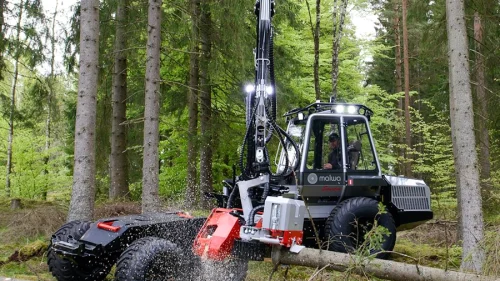
Malwa 560C: Electric Powertrain Innovation
Can a fully electric powertrain outperform traditional forestry machinery? The Malwa 560C project shows how direct-drive electrification, smart hydraulics, and modular batteries are reshaping off-highway vehicle design.
Explore the engineering innovations behind the transformation and discover what OEMs can learn from one of the industry’s most ambitious electrification projects.