

Rotary and Angular Sensors for Industrial and OEM Applications
We offer a wide range of rotary and angular sensors for industrial automation, mobile machinery, robotics, and OEM equipment.
Our portfolio includes single-turn and multi-turn sensors based on Hall-effect and potentiometric technologies, designed to provide reliable and accurate position feedback in demanding operating environments. The best technology depends on operating conditions, environmental exposure, required lifetime, and project budget.
Read more
Programmable Sensors
Many of our Hall-effect rotary sensors are fully programmable, allowing machine builders and system integrators to customize:
- Angular measurement range
- Output signal characteristics
- Rotation direction
- Redundant outputs and safety functions
- Analog and digital interfaces
This flexibility simplifies integration and helps optimize sensor performance for specific machines and control systems.
What Is a Rotary or Angular Sensor?
A rotary sensor, also called an angular sensor or encoder, measures rotational movement around a shaft or axis and converts it into an electrical signal. The sensor provides feedback about angular position, direction of rotation, and sometimes rotational speed.
Depending on the sensing technology, the sensor detects changes in magnetic fields, electrical resistance, optical patterns, inductance, or capacitance. The measured movement is then converted into analog or digital output signals for machine control and automation systems.
Hall-Effect Rotary Sensors
Hall-effect rotary sensors use contactless magnetic field detection to measure angular position. Because there is no mechanical contact between moving parts, these sensors offer long service life and high reliability in harsh environments.
Advantages of Hall-Effect Sensors
- Contactless operation with minimal wear
- Long operational lifetime
- High resistance to dust, vibration, and moisture
- Compact and robust design
- Stable output signals
- Programmable electrical characteristics
Hall-effect sensors are widely used in industrial automation, mobile hydraulics, robotics, servo systems, and automotive steering or pedal applications.
Potentiometric Rotary Sensors
Potentiometric rotary sensors use a mechanical wiper moving across a resistive track to generate a position-dependent analog signal. They provide a simple and cost-effective solution for industrial position feedback.
Benefits of Potentiometric Sensors
- Economical sensor technology
- Direct analog output
- Simple integration into control systems
- Reliable performance in standard industrial applications
These sensors are commonly used in machinery, actuator systems, and applications requiring straightforward analog position measurement.
Single-Turn and Multi-Turn Sensors
Single-Turn Sensors
Single-turn sensors measure angular movement within one full rotation, typically 0° to 360°.
Typical applications include:
- Valve position sensing
- Steering angle measurement
- Pedal position feedback
- Actuator control
Multi-Turn Sensors
Multi-turn sensors track multiple shaft revolutions while maintaining accurate position information. They are used in applications where several rotations must be measured continuously.
Typical applications include:
- Industrial actuators
- Gear-driven systems
- Lifting equipment
- Automated machinery
- Motion control systems
Analog and Digital Output Interfaces
Rotary and angular sensors are available with both analog and digital outputs to support different industrial control architectures.
Common output options include:
- 0–10 V
- 4–20 mA
- PWM
- CANbus
- SSI
- Incremental and absolute outputs
Programmable interfaces simplify integration with PLCs, motor controllers, and industrial communication systems.
Typical Technical Specifications
Available specifications depend on sensor type and application requirements.
Typical options include:
- Measurement ranges up to 360°
- Single-turn and multi-turn configurations
- Analog and digital interfaces
- High-resolution position feedback
- Protection classes up to IP67
- Extended operating temperature ranges
- Shaft and non-shaft versions
- Redundant outputs for safety-related systems
Our engineering team can help identify the correct configuration for demanding industrial and OEM applications.
Typical Applications
Rotary and angular sensors are used across many industries where accurate motion and position feedback are critical.
Common applications include:
- Servo and stepper motor feedback
- Robotics and automation systems
- CNC and packaging machinery
- Mobile and construction equipment
- Industrial valves and actuators
- Agricultural machinery
- Automotive steering systems
- Medical and laboratory equipment
Accurate angular measurement improves machine performance, positioning accuracy, operational safety, and process reliability.
Engineering Expertise and Technical Support
We help OEM customers, machine builders and system integrators choose the right sensors – both standard and customized. Our team has extensive experience in industrial automation, motion control, mobile machines and safety.
Not all sensors are shown on our website, so please contact us for technical advice and recommendations on the right solution.
| Technology: | Hall-Effect |
| Linearity: | ±0.3% FS |
| Deflection: | 15° – 360° |
| Output: | 0…10V | 0,5…4,5V | ratiometric | 4…20mA |
| Temperature range: | -40°C…+85°C |
| Technology: | Hall-Effect |
| Linearity: | ±0,3 % FS |
| Deflection: | Ex. 3600° |
| Output: | 0…10V | 0,5…4,5V | ratiometric | 4…20mA | 0…20mA |
| Temperature range: | -20°C…+ 85°C |
| Technology: | Hall-Effect |
| Linearity: | ±0.3% FS |
| Deflection: | 360° |
| Output: | < 40mA |
| Temperature range: | -30°C…+85°C |
| Technology: | Hall-Effect |
| Linearity: | – |
| Deflection: | 360° |
| Output: | < 40mA |
| Temperature range: | -30°C…+85°C |
| Technology: | Hall-Effect |
| Linearity: | ±0.3% FS |
| Deflection: | 360° |
| Output: | 0.5…4.5V | 0…10V | 4…20mA PWM | SSI | CANopen |
| Temperature range: | -40°C…+85°C |
| Technology: | Hall-Effect |
| Linearity: | – |
| Deflection: | 360° |
| Output: | A, B, index, 1024 pulses |
| Temperature range: | -40°C…+100°C (125°C) |
| Technology: | Hall-Effect |
| Linearity: | ±0.6% FS |
| Deflection: | 15° – 360° |
| Output: | 0.5…4.5V | 0…10V | 4…20mA | PWM |
| Temperature range: | -40°C…+125°C |
| Technology: | Hall-Effect |
| Linearity: | ±0.6% FS |
| Deflection: | 360° |
| Output: | Dual: 0.25…4.75V + 4.75…0.25V ratio metric |
| Temperature range: | -40°C…+125°C |
| Technology: | Potentiometer |
| Linearity: | ±2.0% FS |
| Deflection: | 85° | 145° |
| Output: | Voltage divider |
| Temperature range: | -40°C…+135°C |
| Technology: | Potentiometer |
| Linearity: | ±2.0% FS |
| Deflection: | 85° | 130° |
| Output: | Voltage divider |
| Temperature range: | -40°C…+125°C |
| Technology: | Potentiometer |
| Linearity: | ±2.0% FS |
| Deflection: | 240° |
| Output: | Voltage divider |
| Temperature range: | -40°C…+125°C |
| Technology: | Hall-Effect |
| Linearity: | – |
| Deflection: | 360° |
| Output: | TTL/RS422 or Push-Pull, 1024 pulses/rev |
| Temperature range: | -40°C…+85°C |
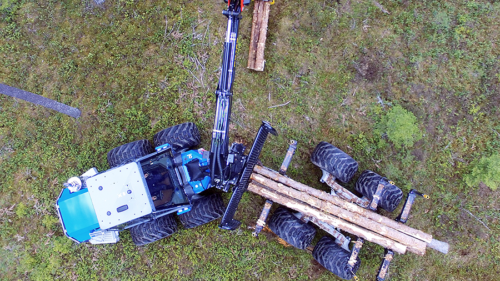
Case
Sensors for Articulated Steering
Articulated vehicles are designed for advanced maneuverability and precision in challenging environments. These vehicles use steering systems to ensure synchronized movements between their front and rear parts. The control over the movements can be maintained using cylinder sensors and rotary sensors.